Yes, but I don’t think most Americans would be willing to do that. I find it ironic that the environmentalists are often the ones driving the SUV and the gas guzzlers and they’re the first to bemoan high gas prices. I’ve spoken at length in the past as to the benefits of higher gas prices. As gas prices increase, you have fewer people on the roads or people begin to drive less. Higher gas prices change consumers’ behavior. If you chart the price of gasoline and gasoline consumption, you’ll find that as prices rise consumption does, in fact, decline. When gas prices spiked back in 2008, gasoline consumption declined by about 3%. Prices fell in 2009 and 2010 then rose again in 2011. When prices rose in 2011, consumption fell by about 3% again. This doesn’t seem much, but it does illustrate that as prices rise, consumers drive less. When the gas prices rose to over $4 per gallon, public transportation ridership increased. It doesn’t seem much in percentage terms, but it equates to about two or three hundred thousand barrels per day. How much would consumption decrease if we did get to $5 per gallon? My contention is that the higher gas prices go the sharper the drop in consumption. Continue reading
Category Archives: Politics
What is the future of Iraq? Are we going to allow Iraq to be controlled by ISIL? Will Iraq break into three countries? Will there be a civil war in Iraq?
I want to start by mentioning something that has been mentioned at this symposium in the past. Keeping the peace is always harder than winning the war. The situation in Iraq is a classic example. It’s been a long and hard effort to keep the peace there after we deposed Saddam Hussein, and I think it’s going to become increasingly difficult to keep the peace particularly as we scale back our presence there. Continue reading
Do we need to re-think our overall foreign policy?
Digger:
What foreign policy? Is our president still going around the world apologizing or is he just going around the world on social calls? Has any of this administration’s foreign policy, if you can call it that, been successful? No. Russia is still in Ukraine. North Korea engaged in cyber warfare and we’ve done nothing about it. We’re normalizing relations with Cuba which has one of the worst human rights violation records in the world. The terrorists are still beheading hostages. Syria’s dictatorship is still battling rebels and terrorists. If we have a foreign policy, it’s a disgrace. Continue reading
Should we negotiate with terrorists? If so, how much is too much when bargaining with them?
I don’t think we should bargain with terrorists at all. It’s a losing proposition. If you give into them once, you’ll be giving into them forever, and you’ll never go back. Bargaining with terrorists sets a dangerously destabilizing precedent. It gives them a sense of legitimacy and makes other terrorists think that we’ll come to the bargaining table with them. Frankly, going to the bargaining table with terrorists is a sign of weakness. You can’t negotiate with people who think you’re weak; that’s a one-sided negotiation and the terrorists would come out ahead. You have to deal with these people from a position of strength. If they say we’re going to kill the hostage unless you give us ten of the prisoners from Guantanamo Bay and then we give them the prisoners, they’re going to go get another hostage and make the same deal or a better deal, and remember that there is no guarantee that we’ll get the hostage back alive. Chances are that they’re going to kill the hostages anyway. But let’s say we do make a deal; then, they’ll keep pushing the envelope. Our position should be that we’re not going to negotiate at all and that if you kill one of our people we’ll hunt you down and kill you and all your terrorist friends.
Now, here’s a sad reality. This is going to end up costing the lives of the hostages. These people don’t deserve to die. I don’t like the idea of sacrificing them, but it’s the sad reality that it’s what we need to do. They were probably just doing their jobs and got caught up in the crossfire so to speak. However, they assumed the risks of going to countries in conflict or countries that harbor terrorists whether they went their willingly or reluctantly as part of their job. They may be workers who didn’t have a choice, but I would hope that their employers would provide adequate security contractors for their protection. Continue reading
Transcript of Digger Cartwright’s Responses at Thinking Outside the Boxe’s 2014 Symposium Question & Answer Session
The following is the transcript of Digger Cartwright’s opening remarks and responses to the question and answer session from Thinking Outside the Boxe’s Annual Symposium held in Orlando from December 26-31, 2014. Continue reading
Mystery Novelist Digger Cartwright Participates in Thinking Outside the Boxe’s 11th Annual Symposium
Orlando, FL, Miami, FL & Washington, D.C. January 26, 2015—The office of Digger Cartwright, mystery novelist and industrialist, released the transcripts of his opening statement and his responses to the question and answer session from Thinking Outside the Boxe’s 11th Annual Symposium held in Orlando from December 26-31, 2014. The symposium focused on a variety of topics such as the politics of sports, the environment, foreign policy, and more.
The transcripts of Mr. Cartwright’s opening statement and his responses in the question and answer session are available at www.DiggerCartwright.com or www.MysteryDigger.com. The transcripts of additional interactions between Mr. Cartwright and other panelists were not made available by Thinking Outside the Boxe.
About Mr. Cartwright— Digger Cartwright is the author of several mystery stories, teleplays, and novels including The Versailles Conspiracy, a modern day political thriller, Murder at the Ocean Forest, a traditional mystery novel set in the 1940s, The House of Dark Shadows, a psychological thriller, and The Maynwarings: A Game of Chance, a mystery set in the Old West. His latest book, Conversations on the Bench, is an inspirational/motivational novel. His books are available in hardback, paperback, and e-book format through his website, www.DiggerCartwright.com, on-line booksellers and bookstores.
Mr. Cartwright has contributed to a number of articles on a wide range of financial, strategic planning, and policy topics. He frequently contributes articles, commentaries, and editorials focusing on current economic and political topics for the private think tank, Thinking Outside the Boxe.
Mr. Cartwright is an enthusiastic supporter of local no-kill animal shelters, the Wounded Warrior Project, and local Meals on Wheels programs.
He enjoys golf, participating in charity golf tournaments, and attending WWE events. He divides his time between Washington, D.C., South Carolina, and Florida.
Press Contact:
Website: http://www.DiggerCartwright.com
Blog: http://www.MysteryDigger.com
Facebook: http://www.facebook.com/DiggerCartwright
Twitter: @mysterydigger
Pinterest: http://www.pinterest.com/mysterydigger
Daily News Briefing: www.MysteryWriterNews.com
###
Top 10 Reasons America is NOT #1

Take a look at why Thinking Outside The Boxe thinks America is still #1
Top 10 Reasons America is NOT #1

Take a look at why Thinking Outside The Boxe thinks America is still #1
Top 10 Reasons America is NOT #1
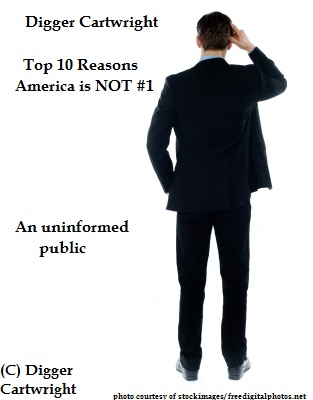
Take a look at why Thinking Outside The Boxe thinks America is still #1
Top 10 Reasons America is NOT #1
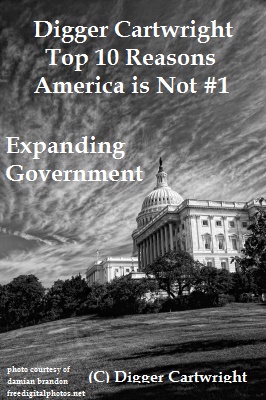
Take a look at why Thinking Outside The Boxe thinks America is still #1
 Digger Cartwright